
Note: this is a guest post by Gilang Mahadika, a Ph.D. candidate at the University of Freiburg
There is a glacier lift standing still, with nobody using it at the moment. The lift infrastructure remains in place even as the glacier itself continues to change. The presence of this infrastructure makes the glacier’s changing condition easy to see. The technology remains the same, while the environment around it is changing.
When I reached the peak, I encountered several tourists speaking Chinese, together with another group of tourists. There are also several children here, apparently not bothered by the cold. Their presence makes the mountain feel less like an extreme or hostile environment and more like an ordinary tourist space. People are taking photographs, moving around, and experiencing the mountain as a place of leisure rather than simply as a harsh alpine environment.
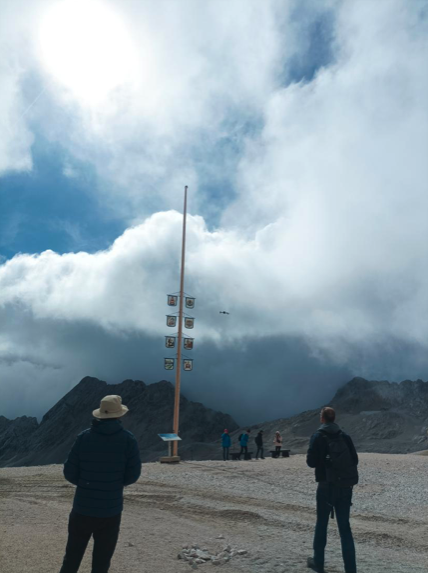
Tourists at the summit of Zugspitze (Gilang Mahadika).
There are also two dogs here. Their presence adds another layer to the atmosphere of the mountain. The dogs seem relatively comfortable in the environment, moving around alongside their owners as if this were an ordinary place to visit. Their presence, together with the children and other tourists, makes the mountain feel surprisingly domesticated and accessible.
A black bird with a yellow beak (Pyrrhocorax graculus) standing close to me suddenly approached, as if checking whether I had any food for it. At first, I was curious to question how a bird can live on Germany’s highest mountain? What does it eat here, and how does it survive in such a cold and exposed environment? Some studies have shown that this species is remarkably adapted to such a high-altitude environment (Burraco, et al., 2025; Roland, et al., 2023, Chiffard, et al. 2019).
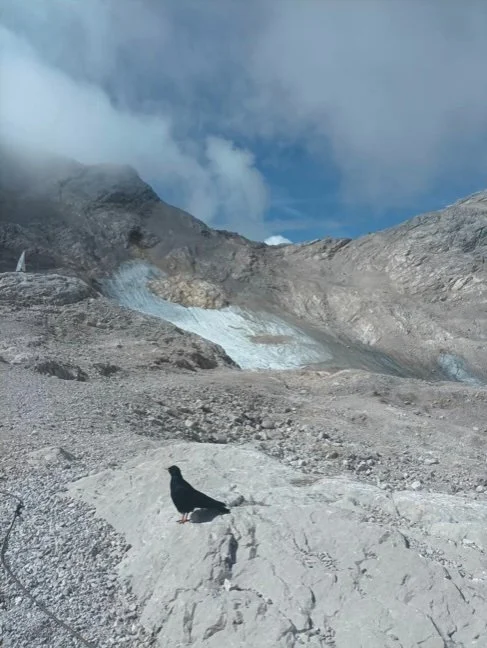
An Alpine chough at the summit of the Zugspitze (Gilang Mahadika)
The weather is very foggy today. At the reception, a staff member told me that the conditions are not really good for seeing the view. I can see the surrounding mountains, but much of it is partially hidden by the fog. The fog changes the experience of the landscape. The mountain is physically present, but it is partially visible.
It is sad to see how much the ice on Zugspitze has already declined. Standing here and seeing the remaining ice in front of me, I think I can now better understand what Antonia Tungel (2026) and the others have been concerned about when they talk about the melting ice. Before coming here, the decline of the glacier was something I mostly encountered through photographs, discussions, readings, and descriptions. Here, however, the process feels more tangible. I am not simply learning about glacier retreat; I am standing in a landscape where the retreat has already taken place.
Regardless of its decline, I can still see the ice. It is still there, standing still, or perhaps appearing to stand still. There is not much of it compared with what must have existed here in the past, but what remains feels significant. These remnants seem almost like traces of another landscape, telling a story of a changing climate through their physical presence. The ice does not speak, of course, but its disappearance and its remaining fragments seem to communicate something about time, change, and the transformation of the mountain.
What I find particularly interesting is that tourists and visitors continue to come to Zugspitze primarily for sightseeing, regardless of whether the ice is there or not. The glacier may be disappearing, but the mountain continues to function as a tourist destination. People still come here to see the landscape, take photographs, experience the altitude, and simply say that they have been to Zugspitze. This makes me wonder whether the disappearance of the glacier necessarily means the disappearance of the mountain as a tourist space. Perhaps the object of tourism can change while the practice of tourism continues.
During our excursion, especially during the “ice rubbings” session, Lindsey Nicholson said something that has remained stuck in my head. She described the ice as trying to “live with” the changing conditions around it, while also having to withstand rocks and other materials coming into contact with and striking against it. What struck me was the way the ice seemed to occupy an ambiguous position. It appears to resist these forces, but at the same time, its resistance exposes its vulnerability to them.
“Ice rubbings,” such an intriguing term. The activity felt both experimental and aesthetic, but also strangely intimate. By searching for ice where the crystals were still relatively intact, we were looking for a part of the glacier that had experienced less contact with rocks and other materials. We then placed water-resistant paper against the ice and rubbed it with a pencil, allowing the pattern of its bubbly crystals to emerge on the paper.
There was something almost sensual about this practice. We were not simply looking at the ice, but getting into contact with it, feeling its surface and tracing its structure. In this encounter, the distinction between life and non-life seemed less clear. The ice appeared not as an inert object, but as something continually coming into contact with other forms of life and non-life, rocks, water, heat, humans, and other beings. Perhaps the activity allowed us to experience the glacier not simply as something we observe, but as something we encounter and live with.
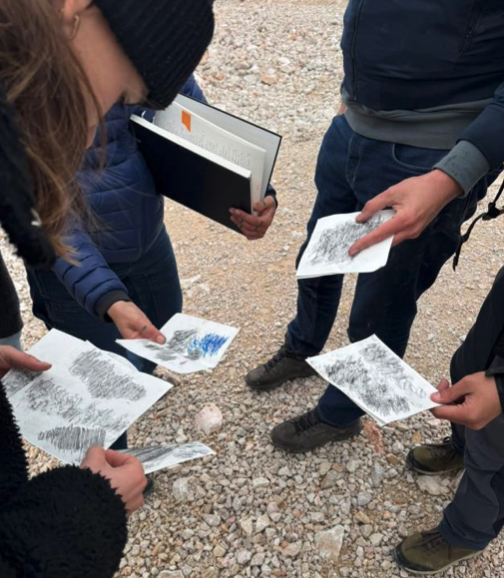
Reading the ice through glacier rubbings (Elizabeth Case)
The ice seems to persist, to endure, and to adjust to changing conditions, while simultaneously becoming smaller and more fragile. What interests me most is Lindsey's phrase “tries to live with it.” It is strange to use the language of living for something that we usually understand as non-living. Yet perhaps this is precisely what makes the glacier so captivating. It asks us to imagine ice not as something simply existing within the world, but as something entangled with it, shaped by heat, water, rocks, and forms of life that emerge around it. The ice does not simply disappear in response to climate change. It persists through it, changes with it, and exists in relation to heat, water, rocks, gravity, and human interventions.
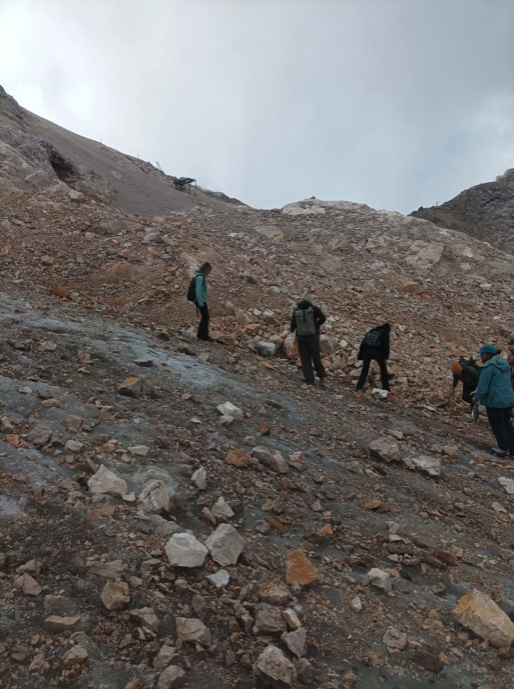
Making contact with the ice during the “ice rubbings” session (Gilang Mahadika)
I do not mean that the ice is literally alive or that it possesses intention in the same way humans do. Rather, Lindsey's formulation makes me question the boundary between resisting and adapting, between life and non-life. Can something be vulnerable and still resist? Can something “live with” changing conditions without being alive?
The remaining ice seems to hold this contradiction. It is disappearing, but it is still here. It is vulnerable, but it also persists. It does not overcome climate change, but neither does it simply cease to exist immediately. It continues to transform and endure within it.
Standing here now, I find myself thinking about the glacier in these terms. The ice is not simply a passive material that is acted upon by climate change. It is continuously encountering heat, water, rocks, movement, and other forces, and it persists through these encounters, at least for now. Its persistence can almost be understood as a form of resistance, although this resistance is not intentional or conscious. At the same time, this apparent resistance should not be confused with strength. The ice is extremely vulnerable. It is changing, retreating, and becoming smaller. It does not simply disappear immediately when exposed to changing conditions, but it endures, transforms, fractures, melts, and continues to exist in altered forms.
Looking at the yellow-billed bird enduring an extreme environment, the ice that persists through the summer, and the tourism that continues to bring people to the mountain, I begin to wonder whether what I am seeing is not resistance to change, but endurance through changes.
REFERENCES
Burraco P, Hawkes L, Pilakouta N, Angelier F, Brans KI, Orizaola G. Evolutionary ecophysiology in extreme environments under a global change scenario. Conserv Physiol. 2025 Aug 11;13(1):coaf059. doi: 10.1093/conphys/coaf059. PMID: 40799845; PMCID: PMC12342908.
Chiffard J, Delestrade A, Yoccoz NG, Loison A, Besnard A. Warm temperatures during cold season can negatively affect adult survival in an alpine bird. Ecol Evol. 2019 Oct 25;9(22):12531-12543. doi: 10.1002/ece3.5715. PMID: 31788195; PMCID: PMC6875669.
Rolando A, Basso C, Brunelli N, Bocca M, Laini A. The foraging ecology of yellow-billed and red- billed choughs changed between two climatically different years. Sci Rep. 2023 Nov 27;13(1):20908. doi: 10.1038/s41598-023-46336-0. PMID: 38016972; PMCID: PMC10684611.
Tungel, Antonia. 2026. Landscape of Loss? The Making and Unmaking of Loss in Alpine Glacier Worlds. M.A. thesis, Albert-Ludwigs-Universität Freiburg.